 Deutsch
  English
 Result
Data-Driven EAM
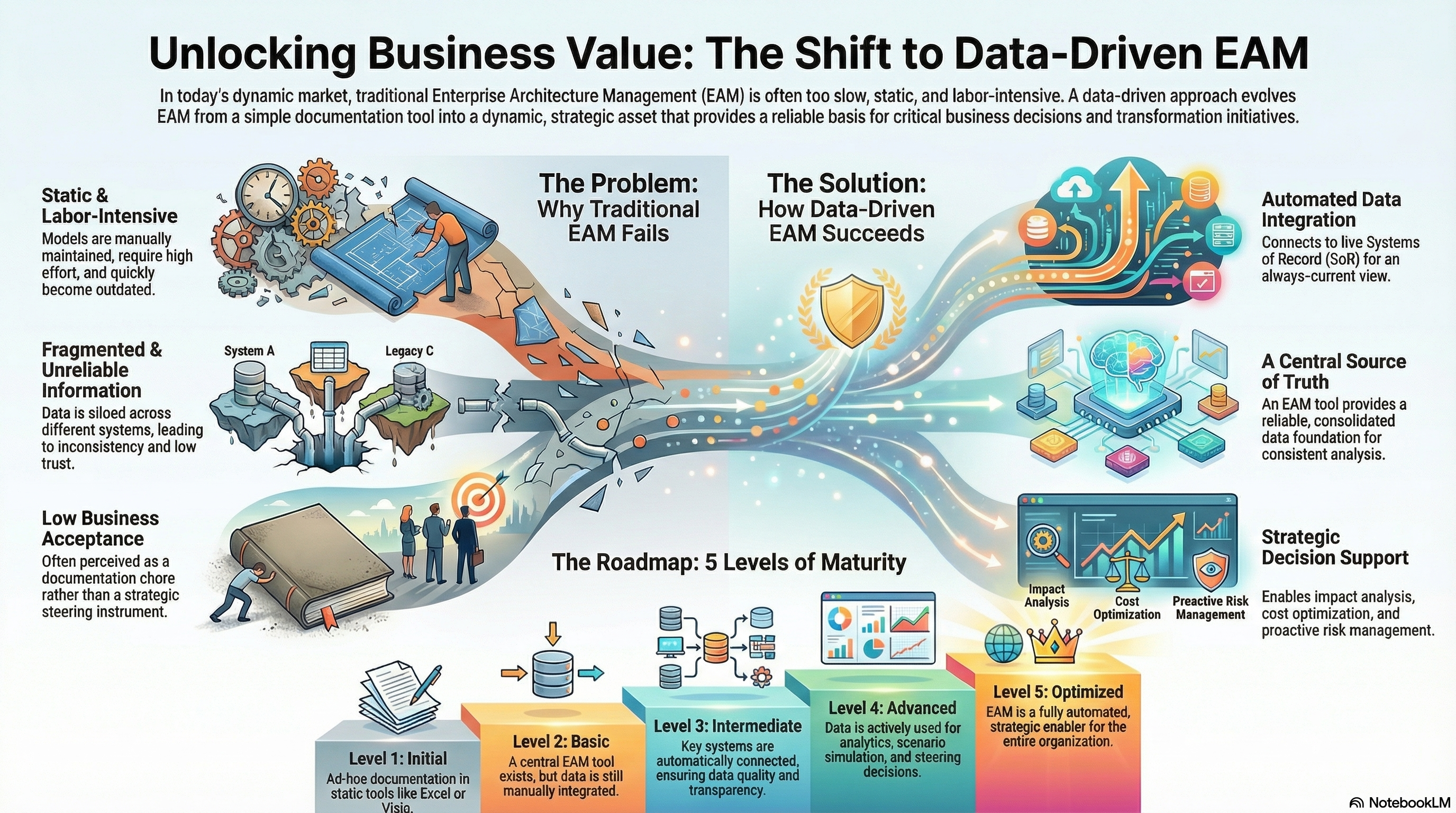
Enterprise Architecture Management (EAM) has evolved from a discipline focused on corporate IT into a tool that strongly supports business-IT alignment and also enjoys a high level of acceptance among business stakeholders – provided that it creates added value for all parties involved and the data for the models and reports in the EAM tool does not have to be laboriously maintained by hand, but is instead largely extracted automatically from various data sources and kept up to date. Once this is achieved, EAM can provide sufficient transparency into the enterprise architecture to make a valuable contribution to analysis and decision-making regarding the optimization of the enterprise architecture.
It is precisely the fact that EAM works with automatically imported, up-to-date data, that the maintenance effort is minimal, and that the results of EAM work provide high added value for both business and IT – these aspects are essentially data-driven.
The Cross-Business-Architecture Lab has published a white paper titled “Data-Driven EAM,” which is available free of charge to association members. It describes the opportunities offered by data-driven EAM, highlights the fundamentals of data processing in EAM, discusses well-known reference models, outlines KPIs and best practices, and presents a maturity model for assessing the maturity of data-driven EAM.
On this basis, the benefits and challenges of a data-driven approach are described, and the requirements for modern EAM tools are outlined.
Finally, real-world use cases are presented that describe in detail how views of the enterprise architecture – i.e., models, diagrams, and reports – can be visualized using EAM tools, and which automatically extracted data from which sources (the so-called systems of record) are utilized.
The white paper concludes with an outlook on the use of AI for EAM, which represents the next stage of data-driven EAM. This can further significantly reduce the maintenance effort required for documenting and analyzing the enterprise architecture and significantly increase the value of the results of EAM work.
A glossary describing key terms used in the white paper rounds out the document.
The detailed use cases for data-driven EAM presented here are based on the real-world experiences of the companies participating in the workstream.
 Join us